Albert Penny Coin Collector · Ohio
Launch promo ends in --:--:--
$47Get the Book · $27
Albert Penny Fifty Years at the Kitchen Table

The Coins In Your Pocket Could Be Worth $500 to $50,000

Most people never look. They spend a 1955 doubled die on a coffee because nobody ever told them what to check. This is the manual that tells you — 34 chapters, 24 teaching diagrams, and a 40-coin scan sheet you keep next to the jar.

34Chapters
150Pages
40Coins To Scan For
Albert Penny at his sorting desk, coin jars on the shelf behind him

“The money in this hobby is not in the one-in-a-million coin. It is in the one-in-two-hundred coin that nobody bothers to look for.”

— Page 12
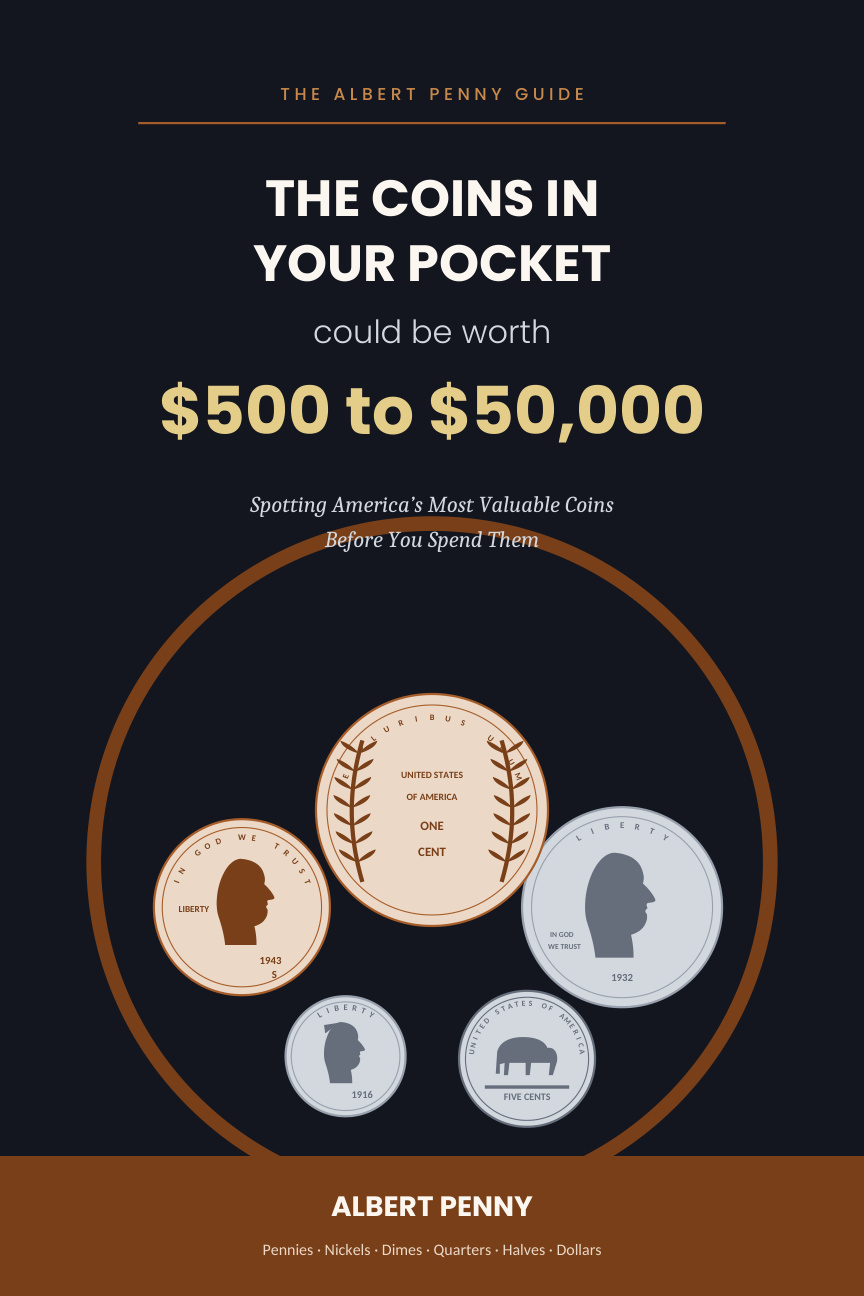
First Edition · 2026 Cover of The Coins in Your Pocket Could Be Worth $500 to $50,000 by Albert Penny
I · The Book

I found four coins in fifty years that were worth more than a month's pay.

Four. I want you to hear that number early, because the internet will tell you otherwise.

There is an entire industry built on a headline that says a penny sold for a million dollars. The headline is true. The odds of that penny being in your sofa cushions are close enough to zero that you should not plan your week around it.

So why write the book? Because between the million-dollar penny and the ordinary cent there is an enormous middle ground that almost nobody checks. There are coins worth twenty dollars and coins worth two hundred and coins worth two thousand moving through American cash registers every single day, and they move through because the person holding them does not know what to look at.

“Here is my promise. I will never inflate a number to keep you reading. Where a coin is common, I will say it is common. Where the odds are long, I will say how long.” Before You Begin · Page 4

This is a working manual, not a coffee-table book about numismatic history. Every chapter is built around one question: is there money in this coin, and how would you know? Each one is short on purpose. You should be able to read one with a cup of coffee and start checking your change that same morning.

II · The Difference

Everybody has a change jar. Almost nobody has a method.

The difference between finding something and spending it is not luck, and it is not a better magnifier. It is knowing which four things to look at, in which order.

How most people check their change

  • Type a date into a phone, land on a million-dollar headline, decide the hobby is a lottery.
  • Compare their coin to a photograph of somebody else's coin, under somebody else's light.
  • Give it a polish so it looks nicer — and quietly destroy most of its value.
  • Mistake a flat machine-doubling smear for a genuine doubled die. Or miss the real one.
  • Read every date on every coin until their eyes glaze over at the fiftieth one.
  • Walk into the first shop they find and take the first number offered.
  • Spend it.

How this book teaches you to check it

  • The four looks — date, mint mark, metal, oddities — about eight seconds a coin, in that order every time.
  • Diagrams, not photographs: everything stripped away except the feature you are checking.
  • Chapter 6 — the one rule that protects your money, and the reason a cleaned coin sells for a fraction.
  • Chapter 7 — doubling, and the difference between $1,800 and nothing. The foundation for six later chapters.
  • Sort by decade first, then read carefully only inside the decades that matter. Several hundred coins an hour.
  • Chapters 30–32 — verify it, grade it, then sell it without getting beaten.
  • Pull it.
III · What's Inside

Thirty-four chapters, grouped by the coins you actually have in the house.

Read Part One properly — everything else stands on it. Then go straight to the denomination filling your jar.

START HERE — Your First Fifteen Minutes

Before chapter one: a four-step search you can run tonight with nothing but your own change and your own eyes. Pull every coin dated 1964 or earlier. Pull every wheat penny. Weigh any 1982 cent. Then look at every date and mint mark twice.

Part One · Learning To See

  1. 1What Actually Makes a Coin Worth Money
  2. 2The Anatomy of a Coin
  3. 3Where the Mint Mark Hides
  4. 4Grading Without a Degree
  5. 5The Five-Tool Kit for Under Forty Dollars
  6. 6The One Rule That Protects Your Money
  7. 7Doubling: The Difference Between $1,800 and Nothing

Part Two · The Pennies

  1. 8Wheat Cents: 1909 to 1958
  2. 9The 1943 Cent and the Copper Mistake
  3. 10The Doubled-Die Cents
  4. 111982: Seven Different Cents, One Date
  5. 12Modern Cents Still In Circulation
  6. 13Indian Head Cents

Part Three · The Nickels

  1. 14Buffalo Nickels
  2. 15Jefferson Nickels and the War Years
  3. 16Nickel Errors Worth Money

Part Four · The Dimes

  1. 17The Silver Line
  2. 18Mercury Dimes
  3. 19Roosevelt Dimes

Part Five · The Quarters

  1. 20Silver Washington Quarters
  2. 21The State Quarter Errors
  3. 22Modern Quarters
  4. 23Standing Liberty and Barber Quarters

Part Six · Halves and Dollars

  1. 24Kennedy Half Dollars
  2. 25Morgan and Peace Dollars
  3. 26Eisenhower, Anthony, and the Modern Dollars

Part Seven · Errors

  1. 27The Error Catalog
  2. 28Damage That Looks Like Money
  3. 29Where to Hunt Errors by Denomination

Part Eight · You Found One

  1. 30Verify Before You Celebrate
  2. 31Grading Services
  3. 32Selling Without Getting Beaten

Part Nine · The Hobby From Here

  1. 33Coin Roll Hunting
  2. 34Storing and Growing a Collection

Part Ten · Appendix

  1. The Forty-Coin Scan Sheet — every coin worth stopping for, with how to identify it and what it brings
  2. Your Coin Log — the pages that stop you searching the same jar twice
  3. Glossary — every term in the book, in plain language
Get the Book · $27
Instant download · Yours forever
IV · Reader Results

What people find once they start looking properly.

◉ ◉ ◉ ◉ ◉

“I emptied the coffee can my father kept on the fridge and ran the first-fifteen-minutes search on the kitchen table. Eleven wheat cents and three silver dimes out of one jar. I had walked past that can for nineteen years.”

Placeholder · Reader, Pennsylvania
◉ ◉ ◉ ◉ ◉

“The chapter on doubling is the one. I had been calling every smeared date a doubled die. Albert shows you the flat shelf that means machine doubling in about two pages, and now I can tell in a second.”

Placeholder · Reader, Ohio
◉ ◉ ◉ ◉ ◉

“What I appreciate is that he tells you when the answer is nothing. Half the book is talking you out of the coin you were hoping for. That is exactly why I trust the other half.”

Placeholder · Reader, Arizona
Albert Penny
V · About

Albert Penny

Ohio. Fifty-odd years at the same table, with the same lamp.

I started the way most people start. I was nine years old and my grandfather kept his change in a coffee can on top of the refrigerator. One rainy Saturday he took it down, poured it out on the kitchen table, and taught me to look at the dates. We found a 1943 steel cent that afternoon and I thought we had struck oil.

It was worth about forty cents. I have been looking at coins ever since.

I am not a dealer and I am not an appraiser. I am the fellow people in this county bring a shoebox to when a relative dies and nobody knows what is in it. This book is what I say to them, written down properly, so you can do it yourself at your own table.

Albert Penny Ohio · 2026
VI · Order

Take the book to the jar tonight.

First Edition · Launch Price

The Coins in Your Pocket Could Be Worth $500 to $50,000

The Albert Penny Guide to Spotting America's Most Valuable Coins Before You Spend Them
  • The complete 150-page guide as a PDF — 34 chapters across 10 parts
  • 24 original teaching diagrams showing exactly where on the coin your eye belongs
  • The Forty-Coin Scan Sheet — every coin worth stopping for, how to spot it, what it brings
  • Your Coin Log pages — print them, or copy the layout into a notebook
  • The glossary — every term in the book in plain language
  • Reads on a phone, a tablet, or a computer. Print the appendix and keep it by the jar.
$47 $27
Launch price · ends in --:--:--
Get the Book · $27
Instant download · Yours forever
Visa · Mastercard · Amex · Apple Pay · PayPal — checkout by Gumroad
VII · Questions

Straight answers.

Are these coins really worth that much? Is this one of those million-dollar-penny things?

No — and the book spends as much time talking you down as talking you up. The famous 1943 bronze cent exists in roughly twenty examples worldwide. You will almost certainly never see one, and I say so in plain words on page 12.

What is realistic is the middle ground: the 1970-S small date, the war nickel, the 1955 doubled die somebody spent because they did not look, the silver quarter in the parking meter change. Those exist in the thousands. Every value in the book assumes a genuine, undamaged coin at a stated grade, and none of them is an appraisal or a promise of what your coin will sell for.

Your videos are free. Why would I buy the book?

Because a video is one coin at a time and you cannot take it to the table. The book is the whole method in the order you actually use it — the four looks, the denominations grouped so you can go straight to the ones filling your jar, and an appendix you print and keep next to the lamp.

It also holds the parts that do not fit in a video: what a cleaned coin costs you, how to tell machine doubling from a doubled die, and what to do in the hour after you find something real.

Why only $27?

Because a book that sits unread on a shelf is worth nothing to either of us, and $27 is the number that gets it onto the table next to the jar. A single silver quarter out of a change bowl covers a good chunk of it. One wheat-cent pile covers the rest.

$47 is where the first edition settles once the launch window closes.

What format is it, and how do I get it?

A PDF, 150 pages, delivered the moment you order. It opens on a phone, a tablet, a laptop, or an e-reader, and it prints cleanly if you would rather have paper — most people print the Forty-Coin Scan Sheet and leave the rest on the phone.

I know nothing about coins. Is this over my head?

It is written for the person who has never used a loupe. Part One teaches you the anatomy of a coin, where the mint mark hides, and how to judge a grade without a degree, and every chapter after it is built to the same shape so you always know where to find what you need.

And you do not have to start at the beginning: the fifteen-minute search at the front of the book works on your first evening.

Does it have photographs of the coins?

No, and that is deliberate. A photograph shows you one particular coin under one particular light. The 24 illustrations are original diagrams — teaching drawings with everything stripped away except the thing you are supposed to be looking at. When you go looking for photographs later, and you should, you will already know what part of the coin your eye belongs on.

Should I clean my coins before I check them?

No. Do not clean anything until you have read Chapter 6. It is the one rule in this hobby that can cost you real money in the time it takes to rub a coin with a cloth, and lustre cannot be put back once it is gone.

Albert Penny
Wait — one thing

Less than one silver quarter.

That is what the book costs. There is a fair chance the change bowl by your door already covers it — you just have not been told what to look at. Thirty-four chapters, and a forty-coin scan sheet you can print tonight.

Get the Book · $27 $47 or see what's inside →